
Banff, Kootenay and Yoho Backcountry National Park Camping
notifications Text me when there's a cancellation at Banff, Kootenay and Yoho Backcountry National Park


Banff, Kootenay and Yoho Backcountry National Park
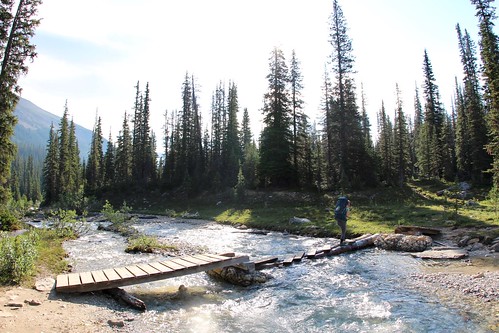
Banff National Park is Canada's first national park, established in 1885 as Rocky Mountains Park. Located in Alberta's Rocky Mountains, 110–180 kilometres (68–112 mi) west of Calgary, Banff encompasses 6,641 square kilometres (2,564 sq mi) of mountainous terrain, with many glaciers and ice fields, dense coniferous forest, and alpine landscapes. It is bordered by Jasper National Park to the north, Yoho National Park and Kootenay National Park to the west in British Columbia, and Kananaskis Country to the southeast. The main commercial centre of the park is the town of Banff, in the Bow River valley.
The mountains were formed from sedimentary rocks that were pushed east over newer rock strata, between 80 million and 55 million years ago. Over the past few million years, glaciers have at times covered most of the park. Glaciers are now found only on the mountain slopes, including the Columbia Icefield, the largest uninterrupted glacial mass in the Rockies. Erosion from water and ice have carved the mountains into their current shapes. Banff National Park has a subarctic climate with three ecoregions, including montane, subalpine, and alpine. The forests are dominated by lodgepole pine at lower elevations and Engelmann spruce in higher ones below the treeline, above which is primarily rocks and ice. Mammal species such as the grizzly bear, cougar, wolverine, elk, bighorn sheep and moose are found, along with hundreds of bird species.
Before the park was established, the Stoney Nakoda and other indigenous people lived in the area, where they maintained subsistence uses including hunting. In 1875, the Canadian Pacific Railway began construction of a transcontinental railroad through the park. Canadian Pacific Railway was instrumental in Banff's early years, building the Banff Springs Hotel and Chateau Lake Louise, which attracted tourists. In the early 20th century, roads were built in Banff, at times by war internees from World War I, and through Great Depression-era public works projects. Since the 1960s, park accommodations have been open all year, with annual tourism visits to Banff increasing to over 5 million in the 1990s. As Banff has over three million visitors annually, the health of its ecosystem has been threatened. In the mid-1990s, Parks Canada responded by initiating a two-year study which resulted in management recommendations and new policies that aim to preserve ecological integrity.
Read more about Banff, Kootenay and Yoho Backcountry National Park at Wikipedia
We can help! Many campsite reservations are cancelled daily. Just tell us when you’d like to camp at Banff, Kootenay and Yoho Backcountry National Park, and how long you want to camp for. We’ll text you when a suitable spot opens up!
Scan for cancellationsWhoops! Sometimes we make mistakes. Want to help improve the Banff, Kootenay and Yoho Backcountry National Park listing? Please suggest a correction.
Open to camping at other nearby parks? Here are a few other parks you'll find in the vicinity.
How was your visit to Banff, Kootenay and Yoho Backcountry National Park? Share your review of Banff, Kootenay and Yoho Backcountry National Park and help fellow nature-lovers make an informed decision.
Post a reviewTell us when, where, and how long you want to camp for. We’ll notify you (via SMS) when a suitable spot opens up at that campground—so you can nab that sold-out campsite reservation!

We love camping, and want to help you reserve the perfect campsite!


